

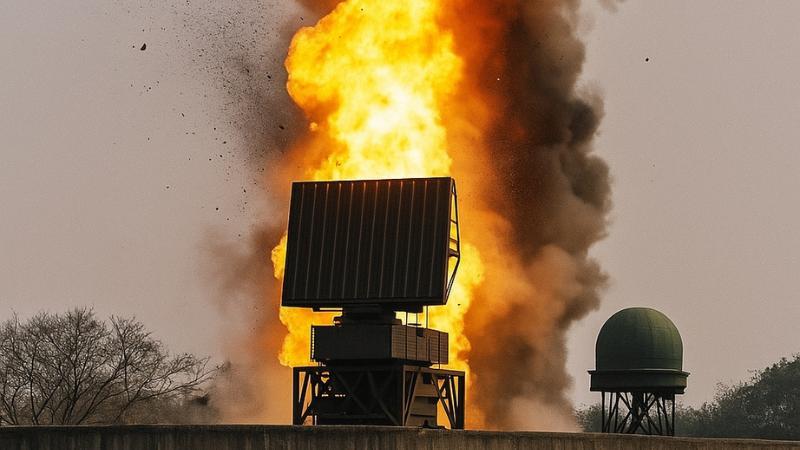
The Indian government stated that these attacks were countered in real-time by India’s advanced air defence network. Indian forces responded "in the same domain and with the same intensity," directly targeting radar and anti-air systems in Pakistan used to initiate the attacks. Cities reportedly targeted by Pakistan included Srinagar, Pathankot, Amritsar, Ludhiana, and Chandigarh. According to officials, all of Pakistan’s launched drones and missiles were successfully intercepted. Debris recovered from these attacks will be used as additional evidence in India’s ongoing campaign to expose Pakistan’s role in cross-border terrorism, especially in light of financial and military support provided to terror outfits.
This escalation attempt occurred just 24 hours after India carried out Operation Sindoor, a swift 25-minute precision strike on nine terror camps four in Pakistan and five in Pakistan-occupied Kashmir (PoK). The Indian Air Force used advanced munitions including SCALP missiles and HAMMER bombs to destroy terror group headquarters and training centers, specifically those operated by Lashkar-e-Taiba and Jaish-e-Mohammed. These strikes were a direct retaliation to the April 22 Pahalgam terror attack, in which four Lashkar proxies from The Resistance Front killed 26 civilians in Jammu & Kashmir’s Baisaran Valley. The Indian military stressed that its strikes were focused and non-escalatory, targeting only terrorist infrastructure based on credible intelligence, and not Pakistani military establishments.